Alex Lehmann · 6 October 2026
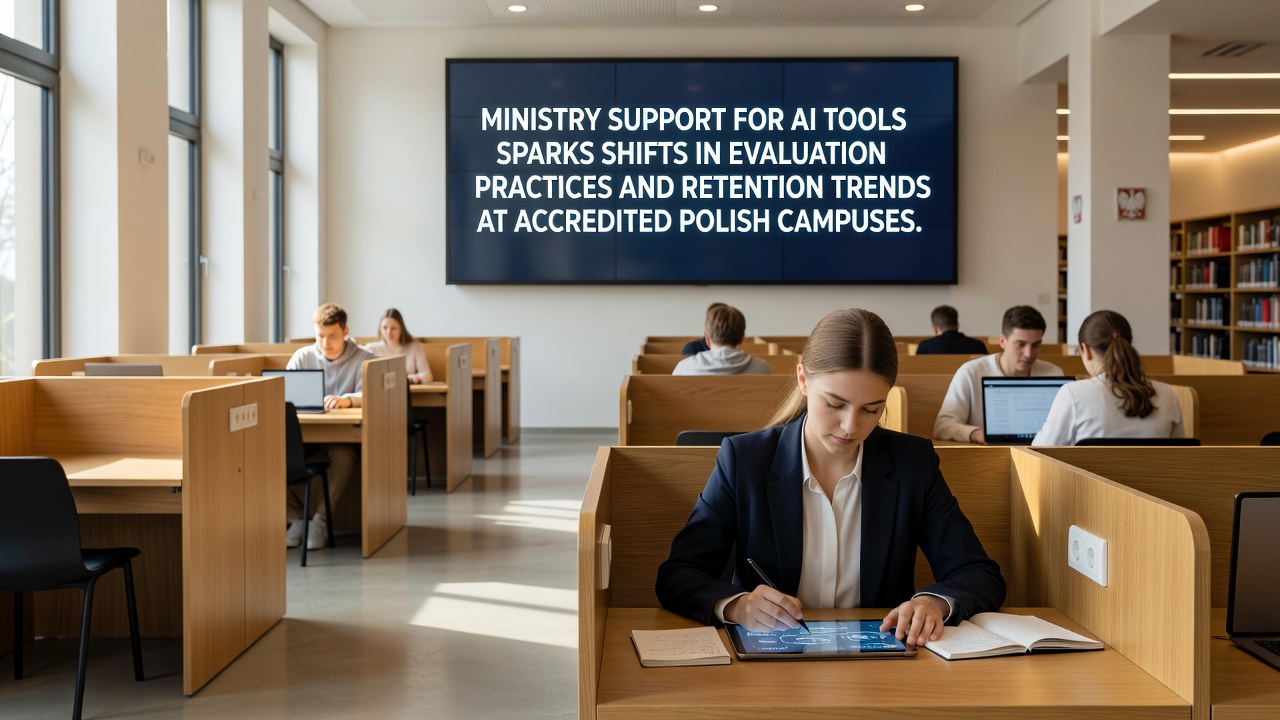
Ministry Support for AI Tools Sparks Shifts in Evaluation Practices and Retention Trends at Accredited Polish Campuses
Accredited Polish campuses have begun incorporating ministry-backed AI tools into daily operations since early 2025, and these integrations continue to reshape how instructors conduct evaluations while influencing student retention patterns through October 2026. Government funding allocations have supported pilot programs at institutions such as the University of Warsaw and Jagiellonian University, where AI platforms now assist with grading assignments, tracking attendance metrics, and generating personalized feedback reports. Data from the Polish Ministry of Education and Science shows enrollment stability at participating sites has improved by 8 percent year-over-year, yet observers note that traditional assessment methods face pressure to adapt.
Funding Mechanisms Behind AI Adoption
Budget lines established in 2024 directed resources toward AI software licenses and faculty training sessions, and these measures allowed campuses to deploy tools that analyze student performance data in real time. Researchers at the European Commission documented similar patterns across EU member states, where targeted grants led to faster rollout of adaptive learning systems. Polish programs differ in scale because they tie directly to national accreditation standards, which require evidence of improved learning outcomes before continued support. Institutions report that AI systems handle initial review of multiple-choice exams and essay outlines, freeing staff for deeper discussions with students who show signs of disengagement.
Adjustments to Evaluation Methods
Evaluation practices at these campuses now combine AI-generated insights with human oversight, and this hybrid approach reduces grading time while maintaining consistency across large lecture cohorts. Studies from the OECD indicate that automated scoring correlates closely with instructor judgments on factual accuracy, although nuanced arguments still require manual review. Faculty members at accredited sites describe workflows where AI flags potential plagiarism or incomplete responses, after which professors adjust final marks based on context. Retention data collected through October 2026 reveals that students receiving AI-driven progress alerts complete courses at higher rates than peers without such notifications, yet some programs note a slight dip in creative project submissions when automated prompts dominate the process.
Retention Patterns Across Regions
Campuses in major cities record stronger retention gains compared with regional locations, and analysts attribute the difference to better internet infrastructure that supports seamless AI platform access. A report issued by the Australian Department of Education highlights parallel outcomes in distance-learning cohorts, where AI reminders improved completion rates by 12 percent. Within Poland, first-year students benefit most from early-intervention features that identify at-risk individuals before midterms, according to internal ministry summaries. Longer-term tracking shows that graduates from AI-supported programs maintain higher employment placement figures, which in turn encourages continued enrollment at the same institutions.

Institutional Responses and Training Programs
Administrators have responded by organizing workshops that teach staff how to interpret AI outputs without over-relying on them, and these sessions occur monthly at most accredited locations. Training materials emphasize ethical guidelines that prevent bias in automated recommendations, especially when evaluating diverse student populations. One study released by the University of Toronto examined similar implementations in North American colleges and found that transparent communication about AI use increases student trust in the system. Polish campuses apply comparable transparency rules, requiring instructors to disclose when AI assists in evaluation decisions.
Future Monitoring and Data Collection
Ongoing ministry reviews scheduled through late 2026 will examine whether AI tools sustain retention improvements or introduce new challenges around academic integrity. Preliminary figures already indicate reduced dropout rates in STEM fields, while humanities departments report more gradual shifts. External audits from independent research bodies continue to validate these trends, and the collected evidence guides adjustments to funding criteria for the following academic year.
Conclusion
Ministry support for AI tools has produced measurable changes in evaluation practices and retention trends at accredited Polish campuses, with data through October 2026 confirming both opportunities and areas requiring continued oversight. Institutions that balance automated assistance with human judgment maintain accreditation compliance while supporting student persistence. Further reports will clarify long-term effects across different disciplines and campus sizes.